
In 2026, digital marketing is no longer about chasing tools but about achieving sustainable results. As AI and customer behavior evolve, businesses must adapt quickly. These digital trends are changing how brands connect, convert, and retain customers. Join Webie Vietnam to explore 5 key trends shaping a stronger full-stack digital marketing strategy for long-term growth.
What is Digital Marketing?
Digital Marketing is the process of bringing products and brands to customers through the internet and electronic devices. However, simply posting on Facebook or running Google ads is insufficient.
The true essence of Digital Marketing lies in understanding online user habits to reach them in the most natural way. Instead of using disparate tools, we need to connect them into a continuous journey, guiding customers from the moment they first learn about the brand until they trust and make a purchase. Digital marketing services can be likened to a unified system: data helps us stay on track, while technology is the tool that helps transform business plans into tangible results.
Distinguishing between Digital Marketing and Traditional Marketing
Whether through digital marketing or traditional marketing, both are essential tools that help businesses achieve their common goals: enhancing brand awareness, attracting customers, and driving sales growth.
| Criteria | Digital Marketing | Traditional Marketing |
| Reach Channels | Online (Website, Social Media, Email, Search Engines, Mobile Apps,…) | Offline (TV, Radio, Print, Magazines, Billboards,…) |
| Targeting | Accurate and detailed (based on demographics, interests, behavior, geographic location, …) | Broad and mass-market, making detailed segmentation challenging |
| Measurement | Precise, granular, and near real-time (views, clicks, engagement, conversions) | More difficult, typically based on estimates with a high time lag |
| Cost | Flexible, scalable with small budgets, easy to optimize, and typically offers a higher ROI | Generally requires significant budgets and lacks flexible adjustments |
| Interaction | Two-way interaction (comments, shares, messages,…) | One-way communication (from brand to customer) |
While digital marketing is currently dominant due to its convenience and measurability, traditional Marketing remains essential for expanding brand reach and connecting with specific customer segments. This is also where full-stack digital marketing becomes important, because businesses no longer need isolated tactics but a complete system that connects SEO, paid media, content, automation, and conversion tracking.
5 Key Digital Marketing trends to watch
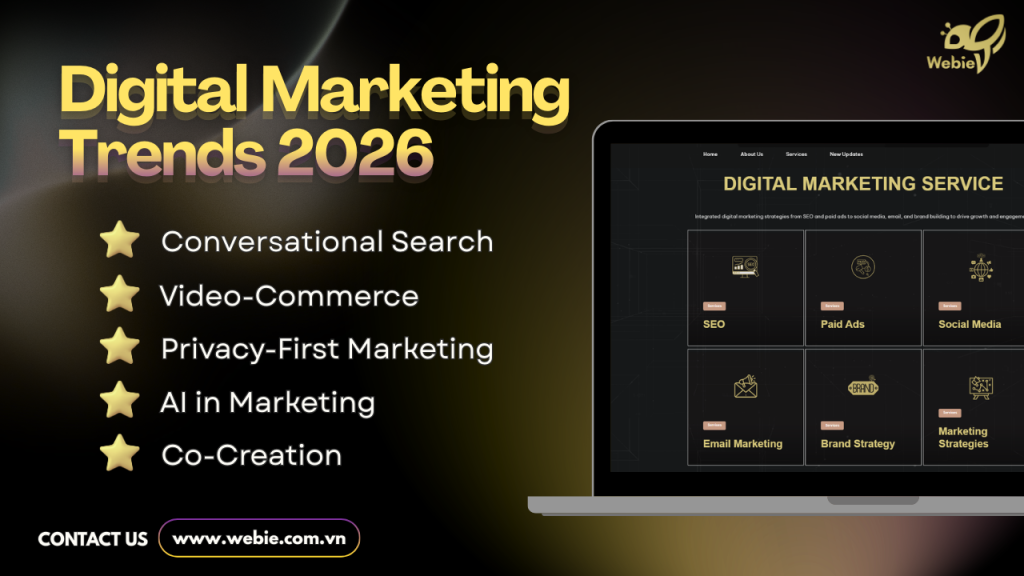
Conversational Search: When searching becomes a conversation
Modern SEO is no longer about stuffing keywords to climb Google rankings; it has evolved into a race to become the “best answer” across all platforms, from AI and social media to voice search. Instead of writing lengthy articles just to drive traffic to a website, you need to create clearly structured content, such as Q&A formats or key point summaries, so that search engines can easily feature snippets immediately. The new goal for SEO specialists is to be present at every touchpoint and provide such high-value, reliable answers that users get what they need without even needing to click a link.
The rise of Video-Commerce
Today, video has moved beyond merely attracting views to become a powerful direct sales tool on TikTok, Reels, and Shorts. With the support of GenAI, producing promotional videos is becoming faster and more accessible than ever. Rather than focusing solely on likes, businesses must now integrate shopping features, embed product links directly into videos, and measure success based on actual revenue instead of just vanity engagement metrics.
Privacy-First Marketing
AI as the “Brain” of Marketing
By 2026, AI will no longer be just a tool for writing or image generation; it will become the “brain” operating the entire marketing ecosystem, from data analysis to process automation. A prime example is Meta’s move toward helping businesses fully automate their advertising: you simply provide the creative assets and a budget, and AI handles everything from design to customer acquisition. The challenge is no longer whether to use AI, but how you prepare your data and orchestrate AI to align with your brand identity and achieve tangible results.
Co-Creation: Joint Content Development
By 2026, Influencer Marketing will no longer be a simple matter of “renting space” on a celebrity’s social media page. Instead of just placing sponsored posts, brands will shift toward co-creating with creators. In this model, the Creator becomes a strategic partner, providing direct feedback for product development, collaborating on long-term campaign concepts, or launching limited-edition collections. The strength of this model lies in creating authentic content that resonates deeply with niche audiences, delivering much higher conversion rates than one-off collaborations.
In short, Digital Marketing 2026 is not just about chasing trends, but about a race for systematic approaches. Businesses need a tightly integrated system between data, technology, and people to create a real competitive advantage. From SEO to AI automation and collaboration with content creators, these digital trends are shaping a new era of efficiency.
Let Webie Vietnam help you build a professional and effective Digital Marketing strategy!
Hotline: 0969 838 467 – Huyen DANG
Email: huyen.dang@webie.com.vn
Website: webie.com.vn
#WebieVietnam #DigitalMarketing #Digitaltrends #SEO #WebieForBusiness