
Data is often called the “oil” of the modern economy. However, as consumers become increasingly concerned about how their personal information is exploited, Privacy-First Marketing has become a mandatory standard for any business aiming to survive and thrive sustainably in 2026.

What is Privacy-First Marketing?
Privacy-First Marketing is an approach that prioritizes user data protection, transparency, and customer control. Instead of trying to collect every possible piece of information through anonymous trackers, this model focuses on obtaining explicit consent and using only the data that is truly necessary.
Why is this trend reshaping the digital marketing landscape?
This shift is driven by three major pressures:
- Legal Regulations: Laws like GDPR (Europe) and cybersecurity regulations in Vietnam are becoming stricter.
- Technological Barriers: Major browsers like Safari and Firefox blocking third-party cookies have made traditional advertising methods less effective.
- Customer Expectations: Today’s users prefer brands they can trust regarding data security.
How does Privacy-First Marketing impact advertisers?
The transition toward prioritizing user privacy creates significant, multifaceted challenges for digital marketing campaigns. Advertisers must unlearn decades of behavior and adopt entirely new methodologies to reach their audiences effectively.
Identifying the target audience has become more difficult
In the pre-digital advertising era, marketers could easily retarget or track potential customers across the internet based on their browsing history. If you saw a pair of shoes on a website, those shoes would appear on your social media page for weeks. By 2026, with increasingly stringent privacy protections, this type of in-depth, cross-platform behavioral targeting is nearly impossible. The lack of identifiable third-party data means that indistinct targeting is no longer an option, forcing brands to find more creative ways to identify their core target customer group.
Measuring and tracing the origin of data has become more difficult`
Traditional analytics tools often relied on cookies to identify where a transaction came from (Meta or Google). In the new era, conversion windows are shrinking, requiring more complex measurement models to evaluate the effectiveness of a digital marketing service.
Personalization in online services requires smarter approaches
Modern personalization must shift from invasive tracking to building trust through transparency and voluntary user data. Instead of “stalking” via third-party cookies, services should prioritize contextual advertising and empower users with control over their own information. The core goal is to provide helpful suggestions at the right moment, ensuring users feel served rather than violated.
Foundations of a Privacy-First Marketing strategy
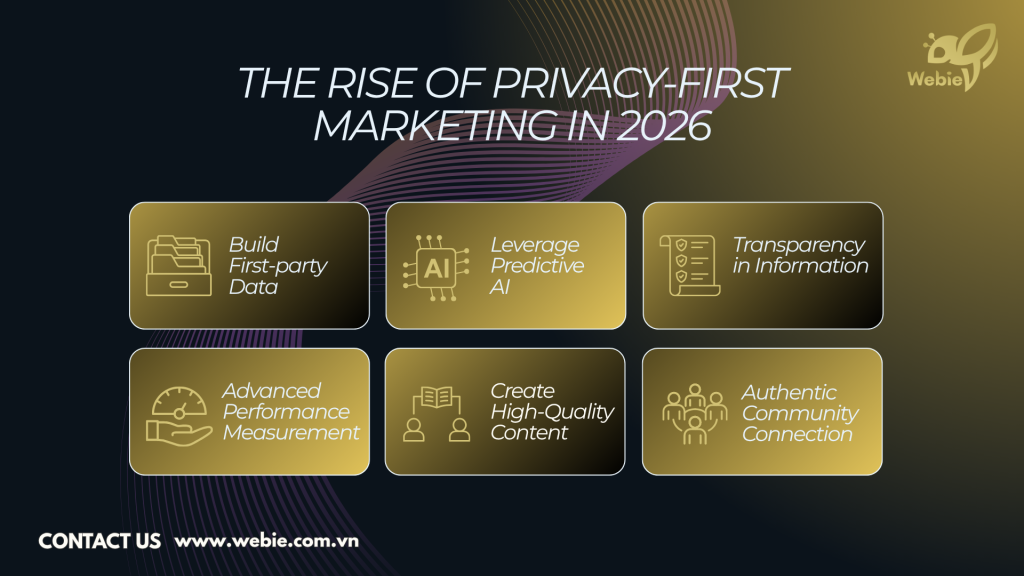
Build a strong First-party data strategy
As third-party data is gradually disappearing, first-party data (information collected directly by your brand) is starting to emerge. To build a sustainable database, companies must encourage users to voluntarily share their information. This is done by offering truly valuable incentives such as exclusive discounts, in-depth industry reportsor curated expert newsletters. Once data is collected through transparent consent, it can be categorized by behavior and preferences, allowing for highly effective personalization while still respecting 100% user choice.
Use AI to predict behavior without violating privacy
Even without cookies, AI plays a crucial role in analyzing trends to predict customer intent, optimize audience segmentation, and improve ad delivery efficiency. Leading platforms like Meta Advantage+, Google Performance Max, and TikTok Smart Bidding now utilize advanced machine learning algorithms. This solution helps campaigns achieve high performance while ensuring complete respect for user privacy.
Transparency of information and building trust with users
To build trust, update your Privacy Policy using simple, easy-to-understand language instead of dry legal jargon. Simultaneously, create clear consent banners explaining: What data are you collecting? What are the purposes of your data collection? And how can users opt out? This approach not only helps businesses comply with regulations but also provides complete peace of mind for customers.
Rethink your digital marketing performance measurement strategy
For optimal efficiency, businesses should switch to Server-side tracking to ensure data accuracy, reduce data loss, and increase compliance. Instead of relying on a single source, combine multiple reporting models like Google Analytics 4, UTM tracking, and internal tools to accurately predict behavior in a privacy-focused future.
Create high-value content users actually want
Privacy-focused marketing encourages brands to “earn” attention rather than “buy” it. To achieve this, you need to build a valuable content library, such as in-depth industry reports, helpful user guides, case studies, detailed tutorial videosor interactive content. This strengthens brand credibility and creates a strong incentive for users to subscribe and stay engaged long-term. This is the essence of sustainable digital marketing trends.
Build trust through community and authenticity
Even with limited access to personal data, brands can still build connections through channels such as influencers, user-generated content (UGC), community engagement, and social proof. In this new era, brand authenticity and genuineness carry more weight than any tracking algorithm.
With Webie Vietnam, you are always protected, competitive, and ready for the future. Contact us today to start your journey toward a secure and high-performing marketing strategy.
Hotline: 0969 838 467 – Huyen DANG
Email: huyen.dang@webie.com.vn
Website: webie.com.vn