
The search world is undergoing a dramatic shift. With the rapid development of AI tools like ChatGPT, Perplexity, Gemini, and Google AI Overviews, users are no longer limited to scrolling through traditional search results. Instead, they receive direct, conversational answers right where they type their queries. This shift has led many marketers to ask: Is SEO still relevant? And if so, how does optimization work in a world where AI performs searches for you?
Traditional SEO hasn’t disappeared, but it is evolving. The natural search strategies that once provided stable traffic and rankings are being tested in real-time as AI-generated content and zero-click search experiences become mainstream. To maintain your presence, you now need to understand not just how people search, but also how machines interpret and present that information.
Why are many people afraid that Artificial Intelligence will “kill” SEO?
This fear is not unfounded. Just look at your own habits: Instead of searching on Google and browsing through 5-10 websites for answers, we now just ask AI and receive a concise summary.
The rise of AI search engines is changing the game. What is artificial intelligence that makes marketers so worried? Simply put, it has the ability to aggregate information from millions of sources in seconds. As search results become smarter, users are less likely to click on traditional website links.
Many think that if AI can create content in bulk, their websites will be buried by mountains of spam. But in reality, Google is smarter than we think. Their algorithm doesn’t measure success by quantity, but by the real value the website provides to users.
Artificial Intelligence is not eliminating but upgrading SEO standards to a new level
Previously, SEO was a race of quantity, focusing on more articles and more keywords; those who did more had the advantage. Now, SEO Google in the age of AI is no longer a race of volume but a battle of understanding. When AI can generate content in bulk, only websites with a solid system, delivering real value, and addressing exact search intent can survive. Ultimately, whoever understands and solves user intent best, wins.
We are shifting from doing SEO for machines to doing SEO for users. Google’s evaluation standards, such as E-E-A-T (Experience, Expertise, Authoritativeness, Trustworthiness), are becoming stricter. AI can write fast, but it cannot replace real experience, personal perspective, or the credibility of a human being. When your content provides unique value, AI will be a companion, not an enemy.
How we leverage AI technology to break through in SEO
Instead of worrying, why not turn AI into a powerful assistant? Here is how I am applying it to speed up my work.
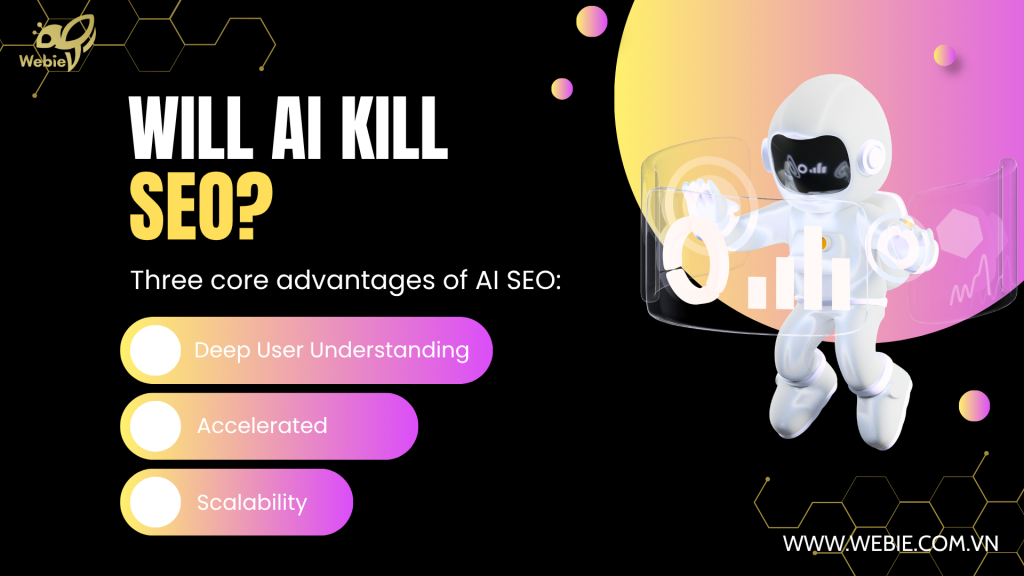
Deeply understand user behavior instead of just chasing keywords
Keyword research is no longer just about checking search volume. You need to use AI to analyze user behavior. Why do they search for that term? What stage of the buying journey are they in? AI helps us decode the intention behind each query, helping you create content that is a true solution to the reader’s pain points rather than just stuffing keywords.
Build a systematic and in-depth content structure
SEO is no longer just about isolated articles. For high effectiveness, you need to build topic clusters. AI technology can help you plan long-term content, linking articles into a solid network of information. This helps Google understand that your website is an expert in that field, leading to more sustainable rankings.
Optimize processes and focus on strategic thinking
Tasks like keyword optimization or outlining that used to take hours now take only minutes. Use the saved time for more important work: improving information quality, adding real experience, and making content soulful. This is when human thinking shines, turning technology into a lever instead of a replacement.
The future of the industry: When GEO (Generative Engine Optimization) takes the throne
As AI becomes more involved in search, we will hear more about GEO (Generative Engine Optimization). If SEO focuses on showing up in a list of links, GEO focuses on getting your brand cited by AI in its direct answers.
To optimize for GEO:
- Use meaningful headings to clearly define sections.
- Write content in a linear, logical structure and limit redundant words.
- Clean up code and formatting so AI crawlers can extract meaning.
- Avoid overly polished or wordy language – keep the tone authentic, clear, and easy to skim.
To adapt, you need to focus on creating high-quality, authentic data with a clear brand style. Google emphasizes the importance of helpful content, and this is the guiding principle for all changes.
Don’t let AI replace your thinking. Start optimizing your content strategy today by sharing this article and leaving your perspective on the future of SEO!
Hotline: 0969 838 467 – Huyen DANG
Email: huyen.dang@webie.com.vn
Website: webie.com.vn