


If your website takes more than three seconds to load, you are losing customers before they ever see your offer, and for a small business, every lost visitor is lost revenue. Website speed is no longer a “nice to have”: Google measures it directly through Core Web Vitals, and shoppers abandon slow pages in seconds. This guide explains what Core Web Vitals are, why speed drives conversions, and the practical steps an SME can take to fix a slow site.
What are Core Web Vitals?
Core Web Vitals are three metrics Google uses to measure real-world user experience, and they factor into search ranking. As of 2026 they are:
- Largest Contentful Paint (LCP): how fast the main content appears. Good: 2.5 seconds or less.
- Interaction to Next Paint (INP): how quickly the page responds to clicks and taps (INP replaced FID in 2024). Good: 200 milliseconds or less.
- Cumulative Layout Shift (CLS): how visually stable the page is while it loads. Good: 0.1 or less.
Google grades these at the 75th percentile of your real visitors across mobile and desktop, meaning three out of four visits should hit “good.”
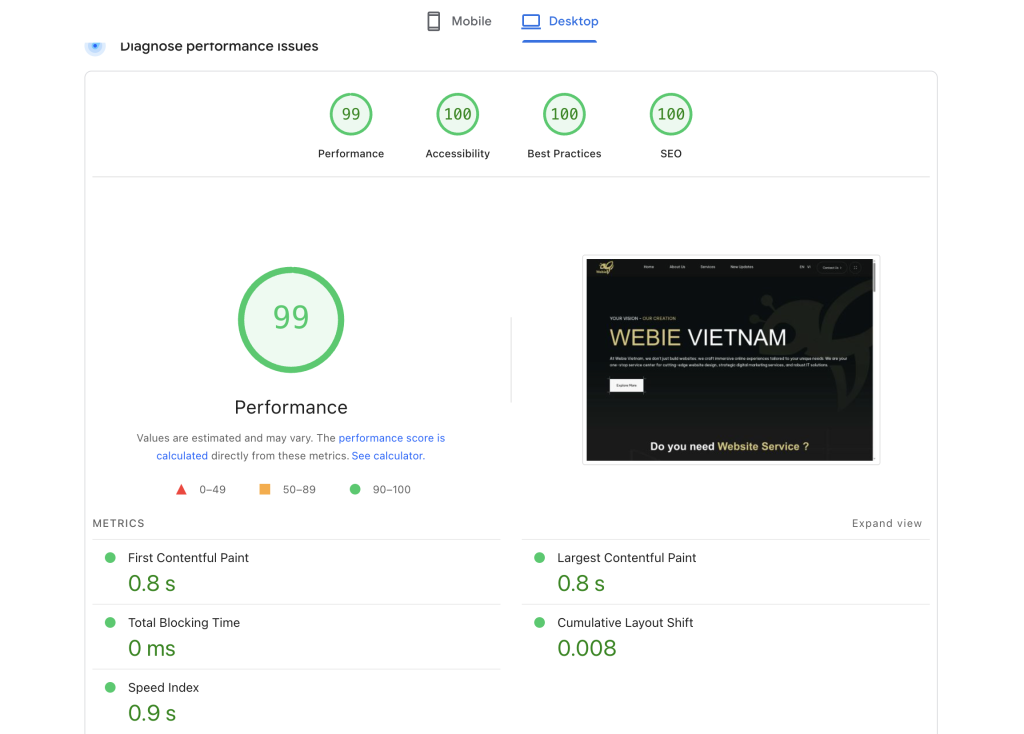
Why speed is a revenue issue, not a tech detail
The numbers are blunt. When load time goes from 1 to 3 seconds, the probability a visitor bounces rises by 32% (Google). 53% of mobile users abandon a site that takes more than 3 seconds to load (Think with Google). And roughly every 1-second delay can cut conversions by about 7% (Akamai). Meanwhile, 47% of users now expect a page to load in under 2 seconds.
It works the other way too. When Vodafone improved its LCP by 31%, it saw a 15% increase in lead-to-visit rate and 8% more sales (Google case study). For an SME running paid ads, this compounds: you pay Google or Meta for the click, then a slow landing page throws away a third of those hard-won visitors before they convert. In short, speed quietly decides how much of your marketing budget turns into real enquiries, and it is one of the few levers you fully control without spending an extra dong on ads.

Where SME websites in Vietnam lose speed
Most Vietnamese SME sites lose speed in a few predictable places: oversized, uncompressed images (especially real estate, F&B, and retail galleries); heavy page builders and stacked plugins on WordPress; third-party scripts (chat widgets, multiple tracking pixels, pop-ups); and cheap shared hosting with slow server response. Add a mobile-first audience on 4G, and a “beautiful” homepage full of high-resolution photos can easily take 6-8 seconds to load, long after half the visitors have already left.
A practical checklist to fix a slow SME website
You don’t need to rebuild everything. Start with the highest-impact fixes:
- Compress and right-size images; serve modern formats (WebP/AVIF) and lazy-load below-the-fold images. This alone often fixes LCP.
- Reserve space for images, ads, and embeds so nothing jumps around as the page loads, this fixes CLS.
- Cut or defer non-essential scripts; keep only the tracking pixels and chat widgets you actually use, this helps INP.
- Enable caching and a CDN so repeat visits and distant users load faster.
- Choose hosting with a fast server response (aim for a low Time to First Byte); cheap shared hosting is a common hidden bottleneck.
- Measure before and after with Google PageSpeed Insights and the Core Web Vitals report in Search Console, use real field data, not guesses.

FAQ
Yes, they are a confirmed ranking signal, though content relevance still matters most. Think of speed as a tiebreaker that also directly affects conversions.
Aim for LCP under 2.5s, INP under 200ms, and CLS under 0.1 at the 75th percentile, and, from a customer’s view, a page that feels usable within 2-3 seconds on mobile.
Run your URL through Google PageSpeed Insights and open the Core Web Vitals report in Google Search Console. Both are free, use Google’s own data, and report mobile and desktop separately, start there before paying for any tool.
No. WordPress can be very fast; the usual culprits are heavy themes, too many plugins, and unoptimized images, all fixable.
Turn speed into customers with Webie
A fast, stable website is one of the cheapest ways to get more out of the traffic you already pay for. If your site feels slow or you’re not sure where it’s losing visitors, Webie can audit your Core Web Vitals and rebuild the slow parts, explore our website design & optimization services, or talk to us directly at hotline +84 969 838 467, email huyen.dang@webie.com.vn.
Sources: web.dev (Core Web Vitals thresholds); Google / Think with Google; Akamai; Google Vodafone case study.

